

If you're deciding between Java and Python in 2026, you're choosing between two of the most powerful and in-demand programming languages in the world.
Both have strong ecosystems, excellent job prospects, and long-term relevance — but they serve different purposes.
This short guide breaks down the key differences to help you make the right choice.
Brief Introduction to Java and Python
Java is a statically typed, object-oriented language known for reliability, scalability, and performance. It’s widely used in enterprise software, backend systems, and Android development. Java was introduced in 1995 by Sun Microsystems.
Python is a high-level, dynamically typed language focused on simplicity and developer productivity. It's famous for data science, AI, automation, and rapid application development. Python was created by Guido van Rossum as side hobby project and released in 1991.
Areas of Usage
Java is widely used for:
- Enterprise backend systems
- Large-scale distributed applications
- Android app development
- Financial and banking software
- High-performance server applications
Python is widely used for:
- Data science and machine learning
- Artificial intelligence and deep learning
- Automation and scripting
- Web development (Django, Flask, FastAPI)
- Scientific computing
Where to Find Python Code Examples
-
Kaggle Notebooks
Explore and run machine learning and data science code.
https://www.kaggle.com/code -
GitHub
Search millions of open-source Python projects and libraries.
https://github.com/search?q=python -
Real Python
High-quality tutorials with practical, well-documented examples.
https://realpython.com
Where to Find Java Code Examples
-
GitHub
Large collection of enterprise, backend, and Android Java projects.
https://github.com/search?q=java -
Baeldung
One of the best sites for modern Java and Spring examples.
https://www.baeldung.com -
Oracle Java Documentation & Tutorials
Official Java examples and learning resources.
https://docs.oracle.com/javase/tutorial/
Java vs Python Comparison
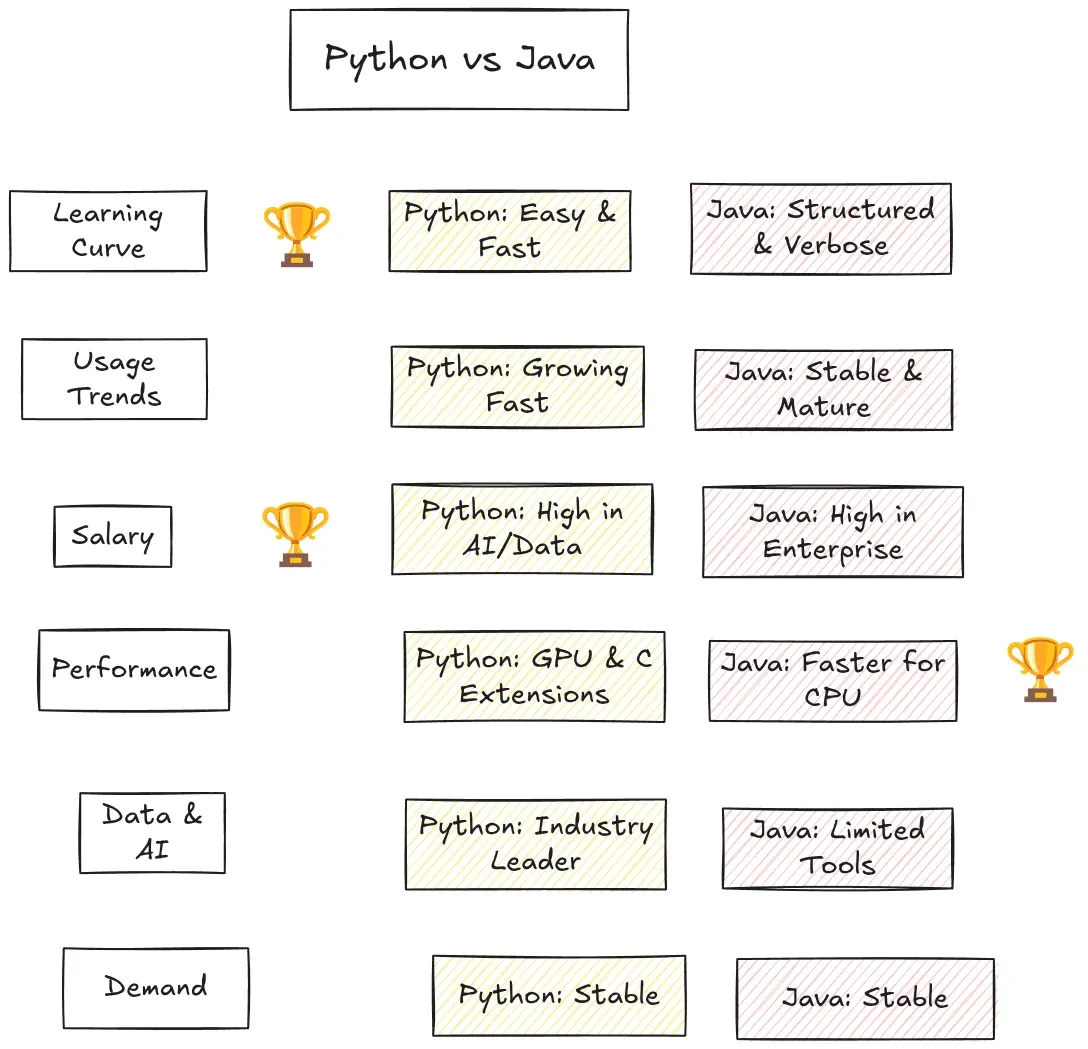
Learning Curve
- Python is easier for beginners due to simple syntax and less boilerplate.
- Java has a steeper learning curve but teaches strong programming fundamentals and system design.
Usage Trends
- Python continues to grow rapidly, driven by AI, data, and automation.
- Java remains stable and dominant in enterprise and backend systems.
GitHub report top languages
According to the GitHub report Python remains dominant in AI and data science with 2.6 million contributors (+48% YoY). Jupyter Notebook remains the go-to exploratory environment for AI (≈403k repositories; +17.8% YoY inside AI-tagged projects).
Python take number 2 position while Java is at number 4.
StackOverflow Most popular technologies
Taken from the report for 2025: SO 2025 Developer Survey
After more than a decade of steady growth, Python's adoption has accelerated significantly. It saw a 7 percentage point increase from 2024 to 2025; this speaks to its ability to be the go-to language for AI, data science, and back-end development.
Python take number 4 position while Java is at number 7.
Job Demand
- Both languages have strong global demand.
- Python roles are common in AI, data science, and DevOps.
- Java roles dominate in enterprise, fintech, and large organizations.
Both have big demand on the popular job offer sites from indeed.com:
- Python - 91,000+ jobs
- Java - 77,000+ jobs
Salary
Salaries are competitive for both:
- Java developers often earn high salaries in enterprise and finance.
- For US the range is: $92K - $152K/yr
- Python developers can earn premium pay in AI, machine learning, and data engineering roles.
- US - $98K - $170K/yr
Performance
- Java generally offers better raw performance and JVM optimizations.
- Python is slower for CPU-heavy tasks but can use C/C++ extensions and GPUs to compensate.
You can find comparison of both for Recursive Fibonacci Benchmark: About
Performance Benchmark of top Github languages
Data and AI
- Python is the clear leader in AI, machine learning, and data science.
- Java has data tools, but its ecosystem is much smaller in this area.
Which One Should You Choose?
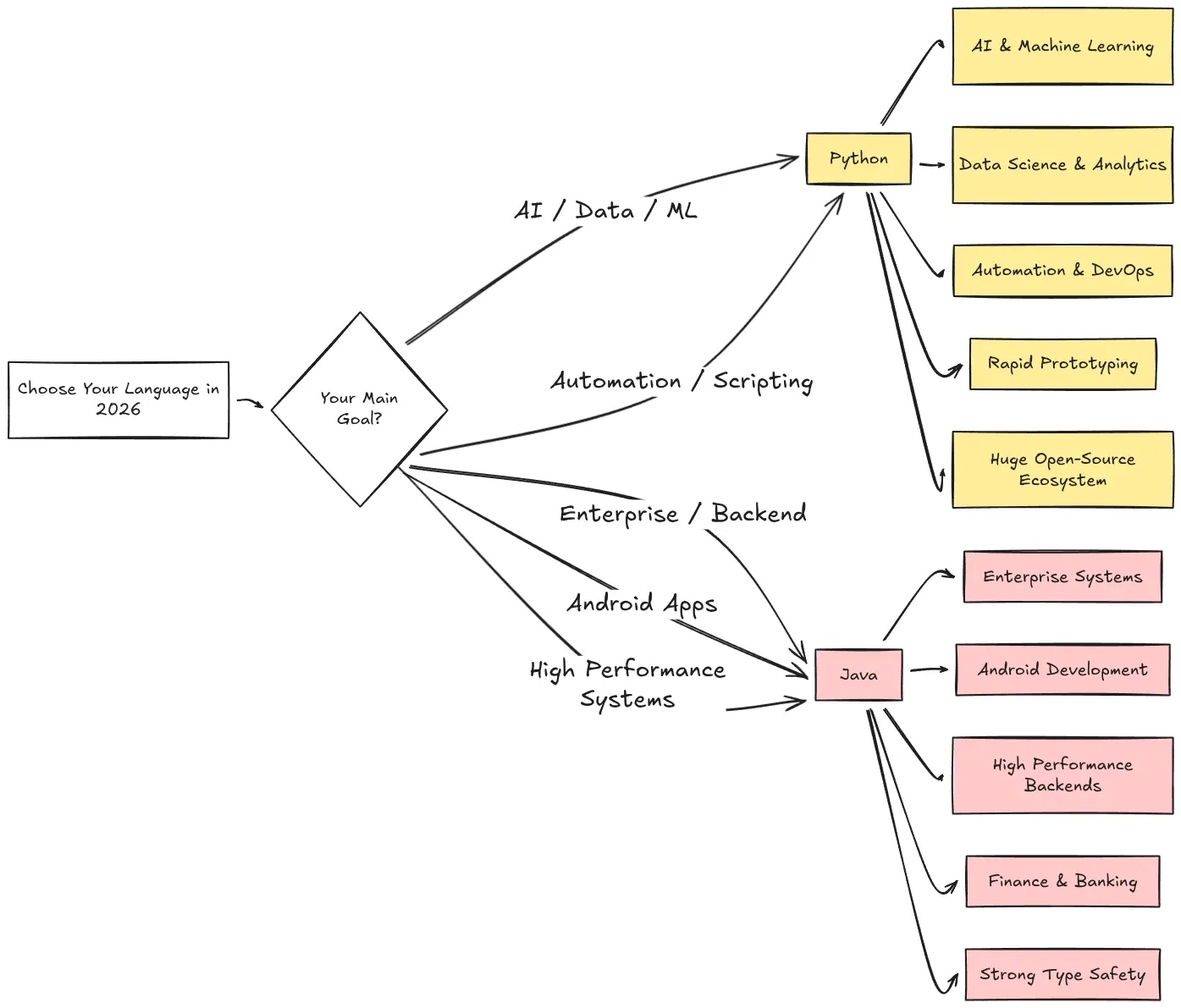
Choose Python if you want to work in:
- AI and machine learning
- Data science and analytics
- Automation and rapid prototyping
Choose Java if you want to work in:
- Enterprise software
- Large-scale backend systems
- Android development
- Financial and banking platforms
In 2026, both Java and Python are excellent choices. The best option depends on your career goals — and learning both can give you a powerful competitive advantage.