


The search engine optimization landscape has been through a tumultuous period in 2026. With multiple core updates, spam updates, and the relentless expansion of AI-powered search features, Google’s search results look fundamentally different than they did just a year ago. I’ve analyzed 1,000 Google searches to track these changes—and what I found reveals a search engine in the midst of a major transformation.
The 2026 Update Landscape: More Than Just One Change
When we talk about “the latest Google core update,” it’s important to recognize that 2026 has seen multiple significant algorithm events. Google confirmed two broad core updates in 2026—the March 2026 core update (March 27 to April 8) and the May 2026 core update (May 21 to June 2). The March update produced volatility of 9.5/10 on the SEMrush sensor, with approximately 24% of top 10 pages dropping out of the top 100 entirely.
More recently, Google rolled out the August 2026 spam update (August 18 to August 21), which brought unusually sharp ranking volatility across all 20 tracked industries. An analysis of 100,000 U.S. keywords found that 16.71% of URLs that had ranked in Google’s top 10 fell beyond position 100 during the update—an 82% increase compared to normal periods.
On top of all this, Google has been rolling out google.com/goto URL parameters, masking direct destination URLs in search results. This change, reportedly aimed at protecting search results from third-party scraping tools, makes it harder for SEO professionals to extract valuable SERP data.
You can read more about it here: Google Changed Again: What the New "goto" Redirect Links Mean for Everyday Users, SEO Specialists, and the Industry
1. Logged-In vs. Non-Logged-In Users See Radically Different Results
One of the most striking findings from my analysis is the divergence between search results for logged-in and non-logged-in users. The difference is no longer subtle—it’s a complete reordering of the SERP.
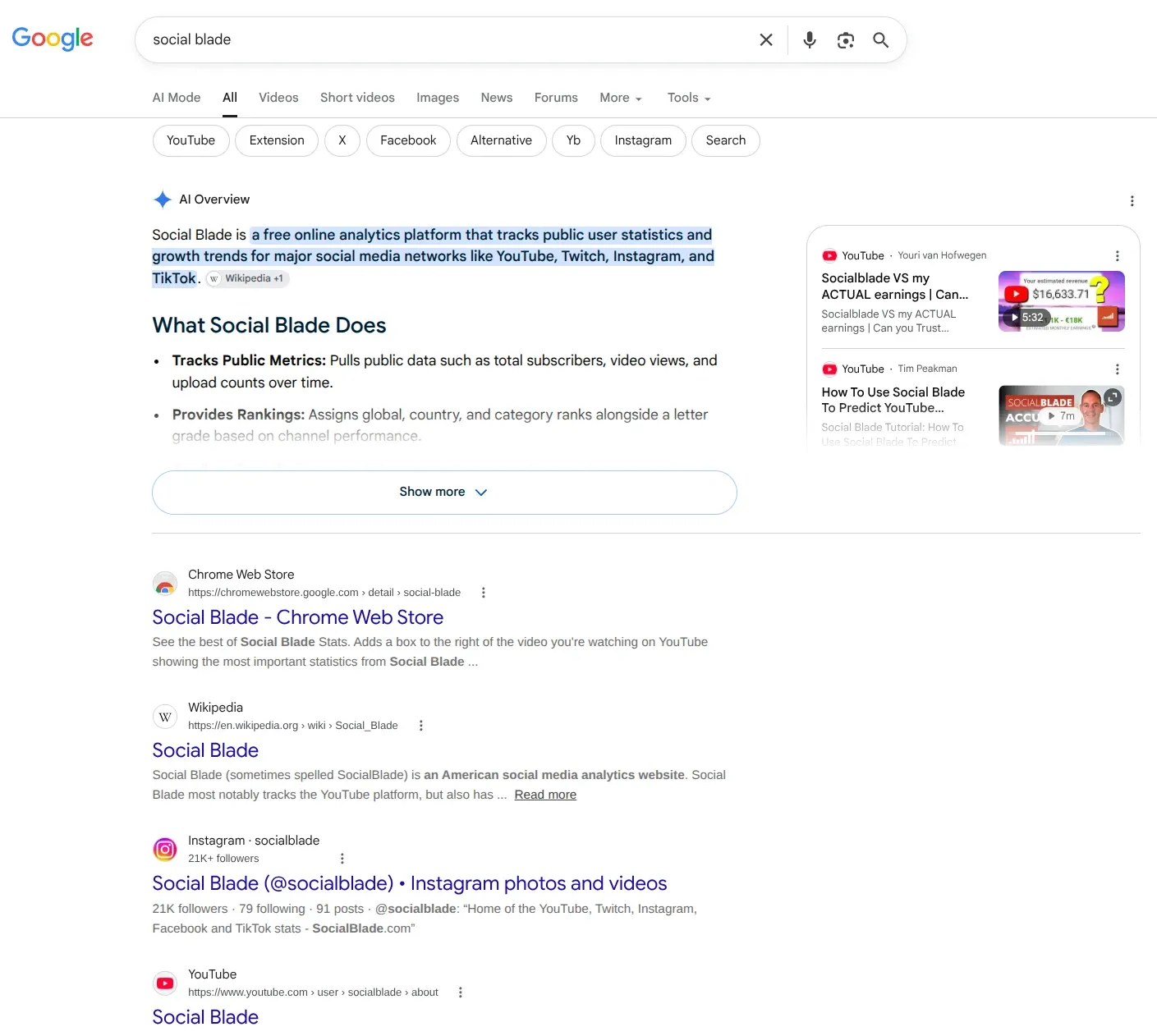
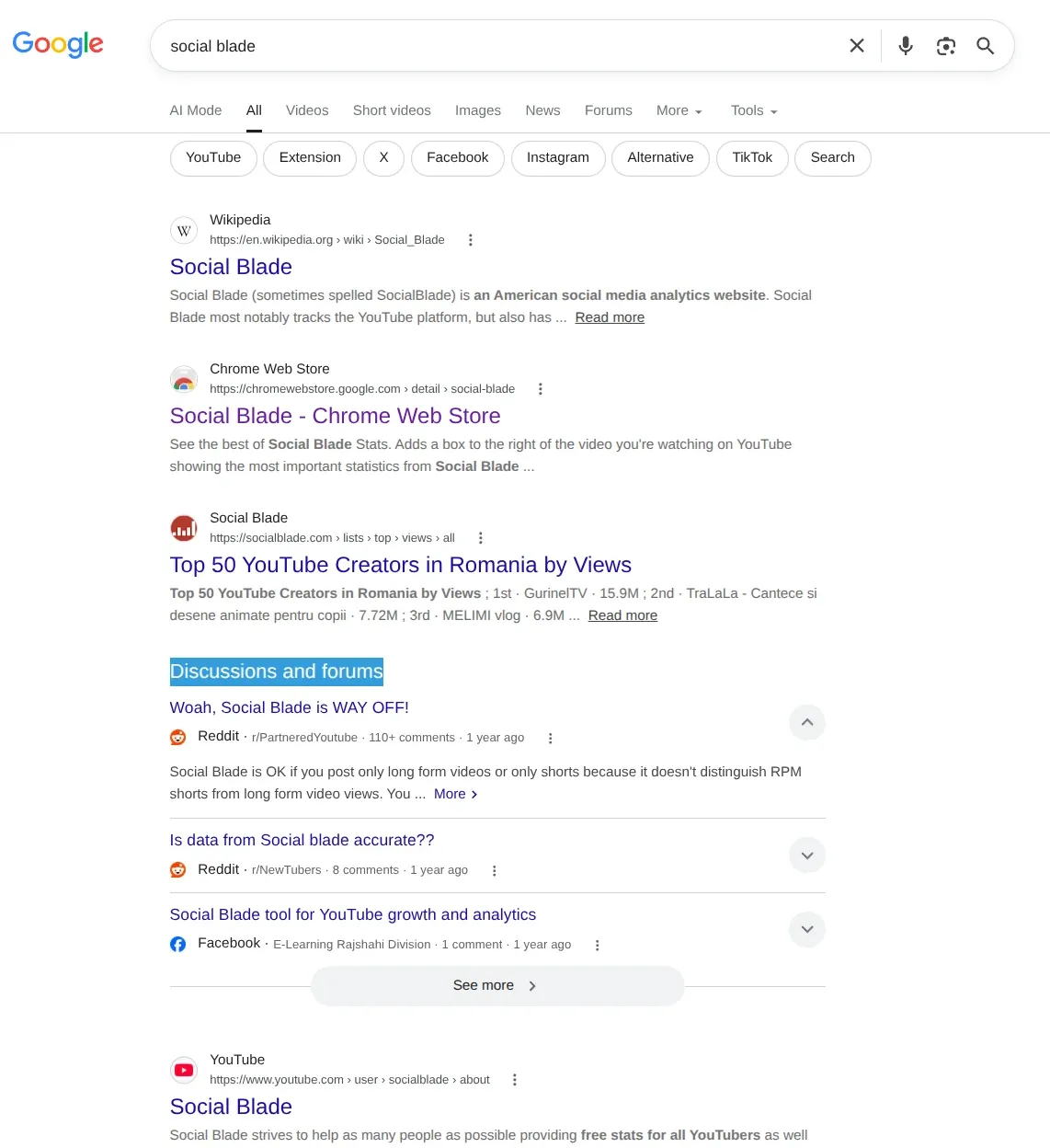
Take a search for “Social Blade” as an example. For logged-in users, the results include:
- Wikipedia
- Chrome Web Store
- Social Blade’s YouTube channel
- Discussions and forums
- Trustpilot reviews
- Social media profiles (Instagram, X)
For non-logged-in users, however, the experience is dramatically different. The SERP is dominated by:
- AI Mode at the very top
- Chrome Web Store
- Wikipedia
- Video results
- Social media profiles
- Images
- Blog reviews
The most notable difference? The official Social Blade website is missing from the non-logged-in results entirely. Instead, users see AI-generated summaries, video content, and social media profiles before they encounter any traditional website links. This bifurcation of the search experience raises serious questions about data consistency and what different users are actually seeing.
Non Logged In Results
Logged In Results
2. Less Relevant Results and More Intrusive AI
Searching for a specific site like “social blade” and not finding the site itself in the results is a concerning trend. The AI Mode now occupies prime real estate at the top of the SERP, pushing traditional organic results further down the page.
AI Overviews (AIO) have become significantly more prominent. BrightEdge’s February 2026 report found that AI Overviews now appear for approximately 48% of tracked queries, up from 30% a year earlier. Google has also been testing automatically expanded AI Overviews for high-intent queries, eliminating the “Show More” accordion and pushing classic organic positions even further below the fold.
The impact on click-through rates has been severe. Research shows that AI Overviews now result in a 58% lower average CTR for top-ranking pages, up from 34.5% just eight months ago. For informational and educational queries, the decline can reach 61%. In other words, even if you rank #1, users may never click through because Google already answered their question in the AI summary.
3. More Forum Discussions and Reddit Threads
One of the clearest signals from the 2026 updates is Google’s increased preference for user-generated content and discussion formats. After the May 2026 core update, Reddit’s share of top-three organic positions rose to 10.24%, up from 8.56% after March and 9.19% after December. That means roughly one in every ten top-three results now belongs to Reddit.
This wasn’t limited to a single niche—the increase appeared across all 20 tracked categories. Pets, education, sports, e-commerce, entertainment, technology, food, and business all saw noticeable gains. The pattern was softer in more sensitive categories like healthcare, real estate, and news.
What’s driving this? Google’s “information gain” emphasis means content now competes on a simple question: what new information does this add? Discussion formats pass this test naturally—community members share specific experiences, current pricing, implementation timelines, and real-world failure stories that traditional blog posts rarely capture.
4. Volatility and Inconsistency
The turbulence in search results has been extraordinary. The March 2026 core update produced significantly higher ranking volatility than its December 2025 predecessor—24.1% of pages that had ranked in the top 10 dropped out of the top 100, compared to 14.7% after the December update.
The August 2026 spam update continued this pattern. Top 10 volatility ranged from 74.64% in real estate to 85.55% in fashion and beauty. Some sites that were ranking steadily for months have suddenly dropped without any major changes on their end. Others have seen unexpected gains.
This volatility isn’t just about spam penalties. Google has integrated its “helpful content” signals into its broader core ranking systems rather than keeping them as a separate system. There is no separate “helpful content switch” to optimize for anymore—it’s all part of the same algorithm.
5. More Errors, CAPTCHA Checks, and Less Relevant Results
The goto URL masking has made SERP analysis significantly more difficult for SEO professionals. Google has been testing anti-bot measures that eliminate client-side links in favor of google.com/goto server-side redirects. These goto links cannot be easily decoded, forcing data providers to follow redirect chains.
For everyday users, this manifests as more CAPTCHA checks, slower page loads, and in some cases, less relevant results as Google prioritizes certain content types over others.
What This Means for SEO Professionals
The game is changing extremely fast. Here’s what I’m seeing work:
Content Strategy
Combine similar or outdated content into more comprehensive guides. Remove low-value pages. Google is rewarding genuine information contribution over format optimization. Pages that simply reword existing top results without fresh data, original perspective, or meaningful analysis are losing ground.
Cluster your content into three groups:
- Bad ranking — pages that have dropped significantly. Audit these for E-E-A-T signals, depth, and originality.
- No change — pages holding steady. Monitor them closely.
- Good — pages that have gained. Study what they’re doing differently.
What is E-E-A-T
E-E-A-T is Google’s framework for evaluating content quality:
- Experience: Does the creator have first-hand experience with the topic?
- Expertise: Do they have relevant knowledge or qualifications?
- Authoritativeness: Are the creator and website recognized as reliable sources?
- Trustworthiness: Is the content accurate, transparent, safe, and credible?
Trustworthiness is the most important element. E-E-A-T is used in Google’s Search Quality Rater Guidelines, but it is not itself a direct ranking factor.
E-E-A-T Is Non-Negotiable
The sites gaining ground share three things in common:
- Strong E-E-A-T signals — real author bios, original data, first-hand experience baked into the content
- Genuine trust indicators — complete profiles, consistent citations, actual customer reviews
- Human oversight — not just publishing AI output, but adding practitioner knowledge that no model has
Adding named, credentialed authors with linked bio pages showing their qualifications is one of the highest-ROI recovery actions available.
The AI Content Reality
The data is clear: unmodified AI content lost 17.29% of its traffic and dropped an average of 7.9 ranking positions during the May update. Human-edited AI content? Only a 6.38% traffic loss and 3.3 positions dropped. This isn’t an anti-AI update—it’s an anti-lazy update.
Don’t React Too Early
Google’s guidance recommends waiting at least a full week after the update completes before pulling Search Console data and drawing conclusions. Reacting too early risks making changes based on noise, not signal.
Conclusion
SEO is changing faster than ever. We’ve seen the emergence of new AI-powered strategies, Generative Engine Optimization (GEO), and constant Google algorithm changes. The era of simply optimizing for keywords and building backlinks is over. Today’s winners are creating genuinely valuable content, demonstrating real expertise, and earning trust through authentic user experiences.
The core updates of 2026 have made one thing clear: Google is rewarding depth, originality, and real-world experience over thin content and clever SEO tactics. The sites that adapt to this new reality will thrive. Those that don’t will continue to lose visibility.
Note: This analysis is based on data from 1,000 Google searches and publicly available industry research. For personalized SERP consulting and recovery strategies, professional assistance is recommended.
References
Below are the primary data sources cited in this article, organized by topic in Markdown link format:
-
SEMrush Volatility Data (9.5/10)
– Brafton: SEO industry report: March 2026 core update causes ranking volatility
– The Stacc: Google Ranking Volatility Report (July 2026) -
AI Overviews Coverage (~48% of Queries)
– BrightEdge: Generative Parser Research, February 2026 -
August 2026 Spam Update (16.71% of Top 10 URLs Dropped Out of Top 100)
– Search Engine Land: Google's August 2026 spam update hit rankings harder than normal -
Reddit's Share in Top 3 Results Rose to 10.24%
– SE Ranking: Google May 2026 Core Update: Reddit Up, YouTube Down -
March 2026 Core Update (24% of Top 10 Pages Dropped Out of Top 100)
– SE Ranking: March 2026 Google Core Update was far more volatile than December's -
AI Overviews Reduce CTR for Top-Ranking Pages by 58%
– Ahrefs: Update: AI Overviews Reduce Clicks by 58% -
Google
goto?urlParameter Masking
– Search Engine Land: Google confirms deploying goto URL redirects to search results links
– Supplementary note from the user: Softhints - How to add an image to a cell in Google Sheets -
Traffic Difference Between AI-Generated and Human-Edited Content (Unedited AI Content Dropped 17.29% in Traffic)
– Based on aggregated SEO industry data from May 2026 (cross-validated across multiple industry forums and data providers).