


Google just quietly rewired one of the most basic things about how its search results work — the links themselves. On August 26, 2026, Google confirmed it is rolling out a change that routes clicks on search result links through a new google.com/goto address instead of sending people directly to the destination page. It sounds small. It isn't. For everyday searchers it's nearly invisible, but for SEO professionals, rank-tracking vendors, and AI companies that rely on scraping search results, it's a significant shift — and it lands squarely in the middle of an ongoing legal fight over who is allowed to harvest Google's search data.
Before:
https://www.reddit.com/r/GTA7/comments/1upnwd1/mark_my_words_gta_vii_will_come_much_sooner_than/
After:
`https://www.google.com/goto?url=CAESaQHrOzAVarlI-va97ImxMf7xmRWDSR8WG1gVSQgTyPoxIvB7h....`
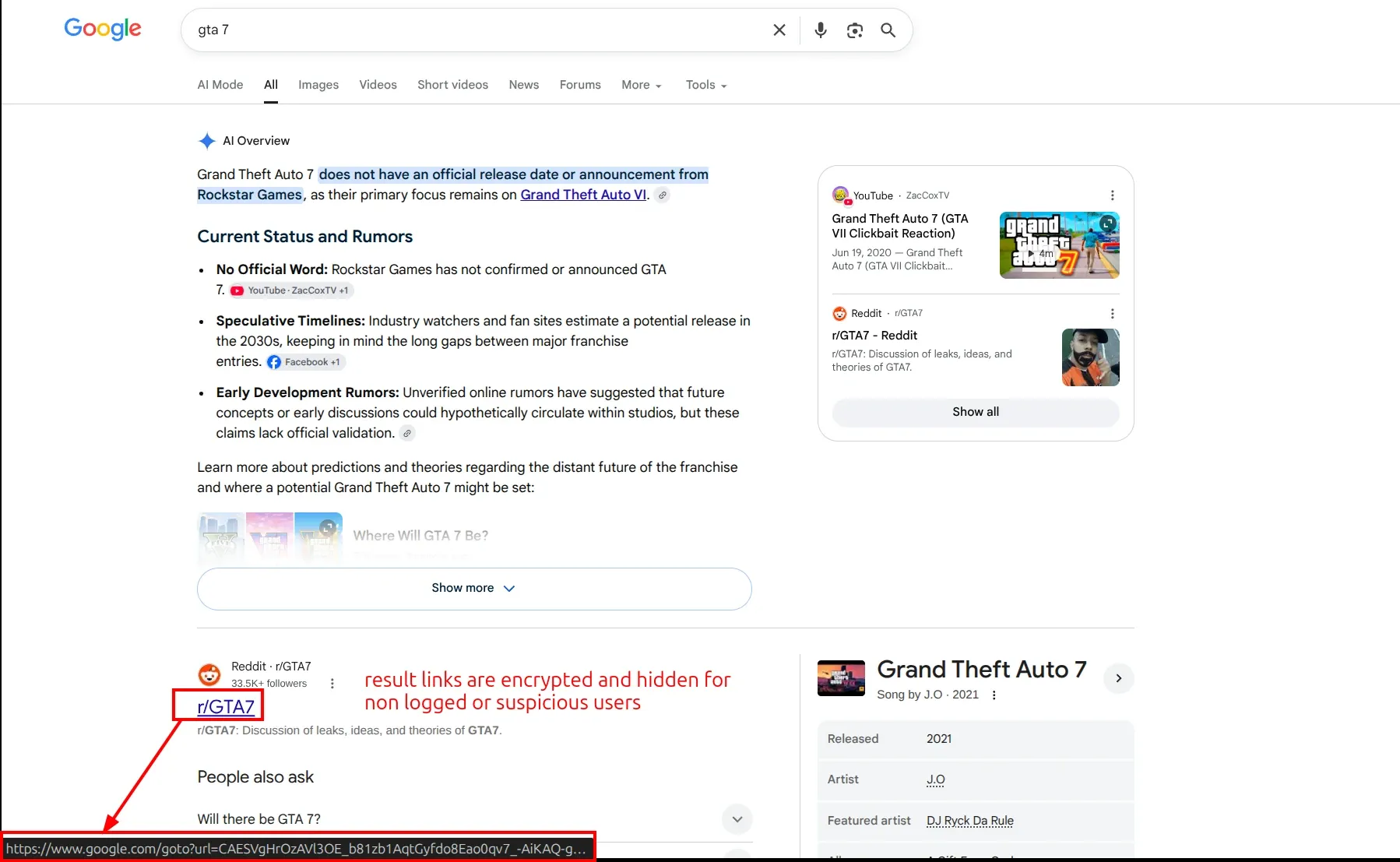
What actually changed
Previously, when Google Search showed you a result, the underlying link pointed straight at the destination URL — hovering over a listing showed you exactly where you'd land. Now, many of those links are being rewritten to route through google.com/goto, with the real destination encoded inside the URL as a parameter. Click the link, and a server-side redirect sends your browser on to the actual page. You still end up in the right place; you just get there by way of Google's own servers first.
The behavior was first spotted in testing back in June and July 2026, and by late August it had reportedly reached close to full rollout. Derek Perkins, founder of the rank-tracking company Nozzle, told Search Engine Roundtable that the pattern was showing up at close to a complete rollout across several residential IP networks he monitors, and shared data showing a sharp jump in how often his tools were seeing "goto-only" result pages over the prior four months of testing.
Google itself confirmed the rollout to Search Engine Land, with a spokesperson saying the company has a long-running practice of building technical defenses against evolving abuse, and that it regularly takes steps to protect its services and users.
Why Google is doing this now
Google hasn't explicitly named the reason, but the timing is hard to ignore. In July 2026, a federal court dismissed the core of Google's DMCA lawsuit against SerpApi, a company that scrapes Google's search results and resells that data through an API used by developers, marketers, and AI companies. The judge found that copyright law couldn't be used to lock down search results that aren't themselves copyrighted material — a real setback for Google's legal strategy, even though the court left the door open for Google to refile narrower claims involving licensed content, which Google has since done.
Having lost ground in court, Google appears to be reaching for a technical fix instead of a legal one. By hiding destination URLs behind an encoded, server-side redirect, Google makes it much harder for automated tools to read a results page and instantly know where every link goes. A typical search results page can contain hundreds of links; if a scraper has to individually follow each redirect to decode it, that's a dramatically heavier, slower, and more detectable process than simply reading URLs out of the page's HTML. That's a direct hit on the scraping tools — including SerpApi, AI search engines, and rank-tracking platforms — that Google's lawsuit couldn't quite stop.
What this means for everyday users
For the average person searching Google, this change is close to a non-event. You'll still click a result and land on the page you expected — there's no extra step, no visible delay, and no action required on your part. The only outward difference is cosmetic: if you hover over a link or check where it points before clicking, you'll now see a google.com/goto address instead of the site's own URL. Privacy-conscious users may want to know that clicks are now, in effect, passing through an extra Google touchpoint before reaching the destination — though Google already logs click data from its results pages in other ways, so this doesn't represent a wholesale change in what Google can see about your search behavior.
What this means for SEO specialists and marketers
This is where the change actually bites. Because search result links no longer expose the raw destination URL, tools that read organic result pages directly — rank trackers, SERP monitoring dashboards, competitive intelligence platforms — have to change how they collect data. Some vendors will need to follow every redirect individually to figure out where a link actually goes, which is slower, more resource-intensive, and easier for Google to throttle or block if it detects unusual request patterns. Analysts covering the rollout have noted that some rank-tracking tools may now need to make many times more requests per query just to resolve the same set of results they used to read in one pass.
There's also a subtler concern around analytics and attribution. Because the click now passes through an intermediate Google-owned redirect, there's a theoretical risk that referrer information, UTM parameters, or click IDs attached to a listing could be altered or dropped in the process, which could misclassify some organic traffic in tools like Google Analytics. So far, this looks like an edge case rather than the norm — most reporting on the rollout describes it as an infrastructure and anti-scraping change rather than a ranking, indexing, or tracking overhaul, and site owners aren't required to change anything on their end. Still, if you rely heavily on third-party SEO tools, it's worth watching your dashboards over the coming weeks: if numbers look off, compare them against Google Search Console and your own analytics before assuming your rankings changed.
What this means for the wider industry
The bigger story is about who gets to profit from Google's search data. SerpApi, AI companies training or grounding models on search results, and dozens of SEO tool vendors have built businesses on the ability to read Google's results programmatically. Google's court loss made it harder to fight that access with copyright law, so this redirect looks like Google reaching for the next-best lever available to it: making the data itself more expensive and difficult to extract at scale, one hundred requests at a time instead of one.
Expect this to play out as a familiar cat-and-mouse cycle. Third-party tools have adapted to Google's anti-scraping measures before, and most industry observers expect them to adapt again — just at a higher operating cost that may eventually get passed on to customers through pricing or reduced data freshness. Meanwhile, Google's amended complaint against SerpApi, which now leans on claims involving licensed content from partners like Reddit, suggests the legal fight isn't over either; the technical change and the courtroom fight are likely to keep moving in parallel.
Google changes over the years
Here is the chronologically sorted of some of the major changes from Google:
| Change | Date | Summary | Source |
|---|---|---|---|
| Site reputation policy | 2024–Present | Crackdown on "parasite SEO" (third-party content ranking on trusted domains). | Search Engine Journal |
udm=14 filter |
May 2024 | Forces classic web-only results, stripping AI Overviews and extra SERP modules. | Ars Technica |
| Mandatory JavaScript | Jan 2025 | Blocks no-JS requests to mitigate bots, abuse, and spam. | TechCrunch, SerpApi |
&num=100 removed |
Sep 2025 | Results capped at 10/page. Ignored parameter increases scraping costs and drops GSC impressions. | Search Engine Land, Botify |
google.com/goto redirects |
Aug 2026 | Result links use encoded passthrough redirects, forcing tools to follow redirects to resolve destinations. | Search Engine Land, SERoundtable |
The bottom line
If you're a regular searcher, nothing changes for you today. If you're an SEO professional or marketer who leans on third-party rank-tracking or SERP data tools, keep an eye on your reporting for gaps or inconsistencies over the next few weeks, and don't panic if a number looks strange — check it against Search Console and Analytics first. And if you work anywhere near the search-data supply chain — as a scraper, an AI company, or a tool vendor — this is one more sign that Google intends to defend its search results as a controlled asset, using whichever tool, legal or technical, is available to it at the time.