


After years of building, abandoning, and rebuilding note systems, I've distilled what actually works into seven operating principles. They won't give you a rigid template to copy—instead, they provide a decision-making framework for when you sit in front of your vault and wonder, "Where does this belong?"
Below is the mental model I used to untangle roughly 7,000 markdown files — all before the AI era, when you couldn't just ask a chatbot to make sense of your chaos for you:
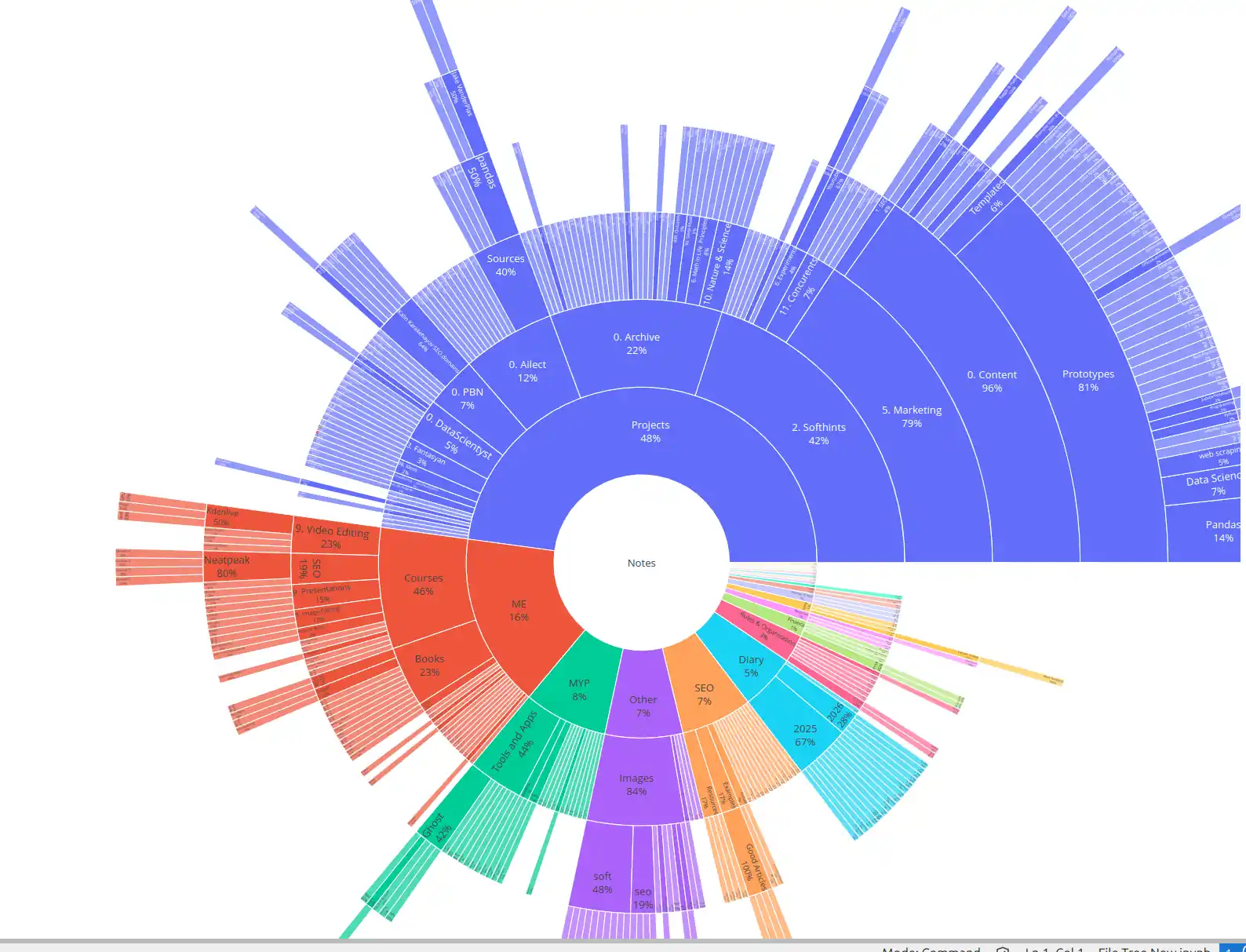
The result: a clean, lean architecture split across multiple vaults. For the first time, I actually know where to find what I'm looking for.
1. Think Continents First, Cities Later
Adopt a top-down approach when structuring your vault. Start with the broadest possible categories—the continents of your knowledge—and only drill down when those categories become crowded enough to demand it.
Imagine organizing a world map. You don't begin by cataloging every street in every neighborhood. You start with continents, then regions, then countries, and eventually, when necessary, cities. Your notes work the same way. Begin with high-level containers like "Work," "Learning," "Projects," or "Life Admin." Resist the urge to create deeply nested folder structures prematurely. Depth should emerge from necessity, not from day-one ambition.
This approach keeps your vault legible at a glance while giving you room to grow. You can always subdivide a continent once you've populated it enough to see its natural borders.
2. Divide and Conquer—Before It Hurts
When a folder crosses some invisible threshold—say, fifty or sixty notes—it's no longer a folder. It's a junk drawer. Split it before it becomes painful.
If your "Projects" folder swells into an unscrollable mess, break it into "Active Projects" and "Completed Projects," or organize by year, or by domain. The same logic applies at the vault level. If your single vault has grown into a bloated monst spanning unrelated areas of your life, consider splitting it into thematic vaults: one for work, one for personal research, one for creative projects. Obsidian handles multiple vaults gracefully, and your future self will thank you for the boundary.
The key is proactive division. Don't wait until finding a note requires a search bar and a prayer.
3. Ruthlessly Curate What You Keep
Too many notes equals no notes. If everything is important, nothing is.
Be merciless about removing what won't serve your future self. That article you clipped three months ago and never read? Delete it. That meeting note from a project that died? Archive or trash it. Your vault should contain signal, not noise. The essential question isn't "Might this be useful someday?" but rather "Will I realistically need this, and will I be able to find it when I do?"
Focus on the essence. A single well-written synthesis note is worth more than fifty raw clippings. Your organizational system can't save you from the burden of excessive, low-value information.
4. Stick to What Works—No Matter What's Trending
There's always a new methodology promising to revolutionize your productivity. Ignore the noise. Once you find a simple convention that works for you, follow it religiously.
If naming your meeting notes YYYY-MM-DD-Client-Topic helps you find things instantly, don't abandon it because someone on Reddit suggested a different format. If folders serve you better than pure linking, use folders without apology. Practicality beats theoretical elegance every time. Make one or two simple rules, apply them consistently, and let compound interest do the rest.
The best system is the one you'll actually maintain.
5. Keep It Simple, Stupid
You've heard this one before. You probably nodded along and then promptly ignored it. Simplicity is the most neglected and underestimated principle in personal knowledge management—and the hardest one to apply.
We have a strange tendency to build cathedral-like organizational structures when a shed would do. Every folder, every tag, every metadata field adds cognitive overhead. Before you add a new layer of complexity, ask: "Is there a simpler way to achieve the same outcome?" Usually, there is. Err on the side of fewer folders, fewer tags, fewer rules. Your brain has limited bandwidth for system maintenance; spend it on thinking, not on tending an elaborate taxonomy.
6. Adapt, Change, Experiment
Your vault is not a museum. Don't be afraid to break things.
The organization that served you six months ago might feel constraining today. That's not failure—it's growth. Move folders, rename links, restructure your MOCs, try a different tagging scheme. Obsidian makes this painless with global search and replace, and the backlink panel ensures you rarely lose connections in the process.
Treat your vault as a living system that evolves with your thinking. Rigidity is the enemy; curiosity is the antidote. If something feels off, it probably is. Trust that instinct and iterate.
7. Shape the Form in the Process
You can't design the perfect vault from a blank slate any more than a sculptor can plan a masterpiece while staring at an untouched block of marble. The clay is softest while you're working it.
Start with a rough vision, but let the final form emerge through use. Create notes, make links, notice where friction appears, and adjust the structure accordingly. Your organizational system should crystalize around your actual patterns of thinking—not around a theoretical blueprint you designed in week one.
The notes organization is a path, not a standing point or perfect shape.
Your vault will never be "done," and that's exactly as it should be. The goal isn't a pristine, immutable system—it's a trusted environment that grows sharper and more useful with every note you take. Start walking the path, stay light on your feet, and let the journey shape the destination.
Check also the next article: Stop Organizing Your Obsidian Notes (Do This Instead)